
Cross Product Magnitude⚠ unverified
Geometry / Vector · Magnitude of a×b (parallelogram area)
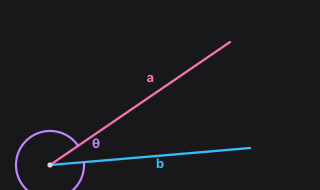
Parameters
| Input | Symbol | Unit | Default | Description |
|---|---|---|---|---|
| ax | ax | m | 1 | Length |
| ay | ay | m | 0 | Length |
| az | az | m | 0 | Length |
| bx | bx | m | 0 | Length |
| by | by | m | 1 | Length |
| bz | bz | m | 0 | Length |
| Output | Symbol | Unit | Description |
|---|---|---|---|
| mag | |a×b| | m^2 | Cross-product magnitude |
The science & history
Understanding the Parameters
- a_x (m) — Length.
- a_y (m) — Length.
- a_z (m) — Length.
- b_x (m) — Length.
- b_y (m) — Length.
- b_z (m) — Length.
- Output |a×b| (m^2) — Cross-product magnitude.
How to Calculate
- Enter Length as
ax(default 1 m). Use the unit menu when you need a different unit. - Enter Length as
ay(default 0 m). Use the unit menu when you need a different unit. - Enter Length as
az(default 0 m). Use the unit menu when you need a different unit. - Enter Length as
bx(default 0 m). Use the unit menu when you need a different unit. - Enter Length as
by(default 1 m). Use the unit menu when you need a different unit. - Enter Length as
bz(default 0 m). Use the unit menu when you need a different unit. - Click Calculate. The card evaluates $|a\times b|=|a||b|\sin\theta$ and shows the result in the declared output unit; Result in (when present) converts that number.
The Science: A Rigorous Derivation (Approaching a Proof)
A Euclidean vector is an arrow: magnitude and direction. The dot product $\mathbf{a}\cdot\mathbf{b} = |a||b|\cos\theta$ is the unique symmetric bilinear form inducing the Euclidean norm. The cross product in $\mathbb{R}^3$ is the unique alternating bilinear map (up to scale) whose magnitude is the parallelogram area and whose direction follows the right-hand rule. The scalar triple product $\mathbf{a}\cdot(\mathbf{b}\times\mathbf{c})$ is the signed volume of the parallelepiped, and vanishes iff the three vectors are coplanar.
Dimensional check. The declared output unit is m^2; ToolBox evaluates the
formula in SI (radians internally for every trigonometric call) and python-calc converts to
the unit on the card.
History and Development
-
Gibbs (1881 notes, 1901 textbook) and Heaviside. The modern $\mathbf{a}\cdot\mathbf{b}$ and $\mathbf{a}\times\mathbf{b}$ notation, distilled from Hamilton's quaternions.
-
Grassmann, Ausdehnungslehre (1844). Exterior algebra — the cross product is a $2$-vector in $3$ dimensions identified with a vector via the Hodge star.
-
Hamilton, quaternions (1843). $ij=k$ is the cross product plus a scalar (the negative of the dot product). Gibbs/Heaviside split that into two operations engineers actually use.
Related Concepts: Vector Magnitude 2D, Vector Magnitude 3D, Dot Product, Angle Between Vectors, Scalar Triple Product, Scalar Projection, Direction Cosine