
Half Angle Sine⚠ unverified
Trigonometry / Identities · Sine of a half angle (non-negative root)
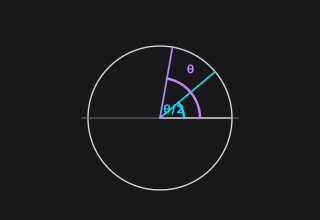
Parameters
| Input | Symbol | Unit | Default | Description |
|---|---|---|---|---|
| theta | θ | degree | 90 | Angle |
| Output | Symbol | Unit | Description |
|---|---|---|---|
| s | sin(θ/2) | — | sin(θ/2) |
The science & history
Understanding the Parameters
- θ (degree) — Angle.
- Output sin(θ/2) — sin(θ/2).
How to Calculate
- Enter Angle as
theta(default 90 degree). Use the unit menu when you need a different unit. - Click Calculate. The card evaluates $\sin(\theta/2)=\sqrt{(1-\cos\theta)/2}$ and shows the result in the declared output unit; Result in (when present) converts that number.
The Science: A Rigorous Derivation (Approaching a Proof)
The addition formulae $\sin(A\pm B)$, $\cos(A\pm B)$ are the angle-addition law of rotations: the matrix $\begin{pmatrix}\cos A&-\sin A\\\sin A&\cos A\end{pmatrix}$ multiplies. Double- and half-angle formulae are the $B=A$ and Weierstrass specialisations. They are identities — true for all $A,B$ where defined — so a calculator that evaluates them is a numerical check and a convenient rewriter, not a solver of a triangle.
Dimensional check. The declared output unit is dimensionless; ToolBox evaluates the
formula in SI (radians internally for every trigonometric call) and python-calc converts to
the unit on the card.
History and Development
Ptolemy's theorem of chords is the cosine addition formula. The full set is in Euler and in every 18th-century analysis book. Prosthaphaeresis (product-to-sum) was a 16th-century multiplication algorithm before logarithms; it is the same identity used backwards.
Related Concepts: Sin A Plus B, Sin A Minus B, Cos A Plus B, Cos A Minus B, Tan A Plus B, Double Angle Sine, Double Angle Cosine, Double Angle Tangent