
Hyperbolic Law Of Cosines Side⚠ unverified
Trigonometry / Hyperbolic · Hyperbolic law of cosines for a side
Parameters
| Input | Symbol | Unit | Default | Description |
|---|---|---|---|---|
| a | a | — | 1.0 | Side a |
| b | b | — | 1.0 | Side b |
| C | C | degree | 60 | Included angle |
| Output | Symbol | Unit | Description |
|---|---|---|---|
| c | c | — | Side c |
The science & history
Understanding the Parameters
- a — Side a.
- b — Side b.
- C (degree) — Included angle.
- Output c — Side c.
How to Calculate
- Enter Side a as
a(default 1.0 dimensionless). Use the unit menu when you need a different unit. - Enter Side b as
b(default 1.0 dimensionless). Use the unit menu when you need a different unit. - Enter Included angle as
C(default 60 degree). Use the unit menu when you need a different unit. - Click Calculate. The card evaluates $\cosh c=\cosh a\cosh b-\sinh a\sinh b\cos C$ and shows the result in the declared output unit; Result in (when present) converts that number.
The Science: A Rigorous Derivation (Approaching a Proof)
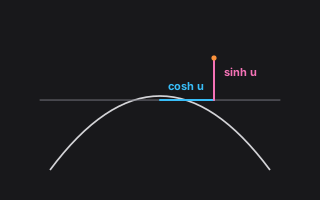
Hyperbolic functions are the coordinates on the unit hyperbola $x^2-y^2=1$: $x = \cosh u$, $y = \sinh u$, with $u$ twice the signed sector area (the analogue of radian measure). The identity $\cosh^2 u - \sinh^2 u = 1$ is that hyperbola. They solve $y''-y=0$ as sine/cosine solve $y''+y=0$, and they are the trigonometry of the hyperbolic plane (law of cosines with $\cosh c = \cosh a\cosh b - \sinh a\sinh b\cos C$). Rapidities in special relativity are the same functions ($\tanh\phi = v/c$).
Dimensional check. The declared output unit is dimensionless; ToolBox evaluates the
formula in SI (radians internally for every trigonometric call) and python-calc converts to
the unit on the card.
History and Development
Ricci and Lambert studied the hyperbola as a trigonometric analogue in the 18th century; Vincenzo Riccati and others introduce $\sinh$, $\cosh$ notation. Osborn's rule converts circular identities into hyperbolic ones by $\sin\to\sinh$, $\cos\to\cosh$, and a sign flip on every product of two sines. The catenary $y = a\cosh(x/a)$ is the physical calling card.