
Linear Speed From Angular⚠ unverified
Trigonometry / Angle Motion · Linear speed from angular speed and radius
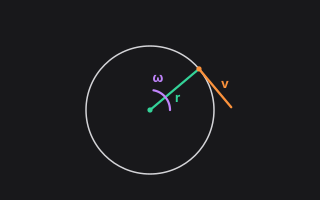
Parameters
| Input | Symbol | Unit | Default | Description |
|---|---|---|---|---|
| omega | ω | radian / s | 5.0 | Angular speed |
| r | r | m | 2 | Radius |
| Output | Symbol | Unit | Description |
|---|---|---|---|
| v | v | m/s | Linear speed |
The science & history
Understanding the Parameters
- ω (radian / s) — Angular speed.
- r (m) — Radius.
- Output v (m/s) — Linear speed.
How to Calculate
- Enter Angular speed as
omega(default 5.0 radian / s). Use the unit menu when you need a different unit. - Enter Radius as
r(default 2 m). Use the unit menu when you need a different unit. - Click Calculate. The card evaluates $v=r\omega$ and shows the result in the declared output unit; Result in (when present) converts that number.
The Science: A Rigorous Derivation (Approaching a Proof)
Angle is arc length per radius, $\theta = s/r$, in radians. Differentiating, the linear speed of a point at distance $r$ from an axis is $v = r\omega$ with $\omega = d\theta/dt$. This is purely kinematic: no mass, no force, only the geometry of a circle and the definition of radian.
Dimensional check. The declared output unit is m/s; ToolBox evaluates the
formula in SI (radians internally for every trigonometric call) and python-calc converts to
the unit on the card.
History and Development
Radians as a unit were named by James Thomson (1873) and popularised by the 1870s textbooks; the relation $v = r\omega$ is older, implicit in Huygens' and Newton's treatments of circular motion. Engineers still mix rpm, deg/s and rad/s — this calculator converts among them via the unit menu.
Related Concepts: Angular Speed