
Prism Volume⚠ unverified
Geometry / Solid · Volume of a prism
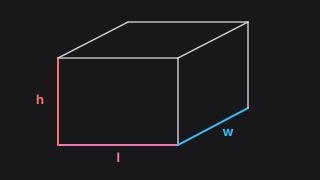
Parameters
| Input | Symbol | Unit | Default | Description |
|---|---|---|---|---|
| base_area | A | m^2 | 6.0 | Base area |
| height | h | m | 4 | Height |
| Output | Symbol | Unit | Description |
|---|---|---|---|
| V | V | m^3 | Volume |
The science & history
Understanding the Parameters
- A (m^2) — Base area.
- h (m) — Height.
- Output V (m^3) — Volume.
How to Calculate
- Enter Base area as
base_area(default 6.0 m^2). Use the unit menu when you need a different unit. - Enter Height as
height(default 4 m). Use the unit menu when you need a different unit. - Click Calculate. The card evaluates $V = A h$ and shows the result in the declared output unit; Result in (when present) converts that number.
The Science: A Rigorous Derivation (Approaching a Proof)
Solid Euclidean geometry extends the plane metric to $\mathbb{R}^3$. Volume is the unique translation-invariant measure assigning $1$ to the unit cube; Cavalieri's principle (if two solids have equal cross-sectional area at every height, they have equal volume) gives the pyramid and cone factor $\tfrac13$ from the prism. Surface area is the $2$-dimensional Hausdorff measure of the boundary. A sphere is the unique surface of constant curvature; its volume and area are the classical isoperimetric extrema.
Dimensional check. The declared output unit is m^3; ToolBox evaluates the
formula in SI (radians internally for every trigonometric call) and python-calc converts to
the unit on the card.
History and Development
- Euclid, Elements Books XI–XIII. Parallelepipeds, pyramids, and the five regular solids.
-
Archimedes, On the Sphere and Cylinder. $V = \tfrac43\pi r^3$ and $A = 4\pi r^2$, of which he was so proud that a sphere-in-cylinder was placed on his tomb. He also treated spheroids, conoids, and the frustum.
-
Eudoxus / method of exhaustion. The $\tfrac13$ pyramid factor predates Euclid; Archimedes makes the limiting argument rigorous.
-
Kepler, Cavalieri, 17th century. Infinitesimal arguments that become calculus; the ellipsoid $V = \tfrac43\pi abc$ is the affine image of a sphere (linear maps scale volume by $\det$).
-
Modern vector calculus. Divergence theorem: the volume formulae are $\tfrac13\int\mathbf{r}\cdot d\mathbf{S}$ over the boundary.
Related Concepts: Cube Volume, Box Volume, Pyramid Volume, Cone Volume, Cylinder Volume, Sphere Volume, Hemisphere Volume, Ellipsoid Volume