
Real From Polar⚠ unverified
Trigonometry / Complex · Real part from polar form
Parameters
| Input | Symbol | Unit | Default | Description |
|---|---|---|---|---|
| r | r | — | 2.0 | Modulus |
| theta | θ | degree | 60 | Angle |
| Output | Symbol | Unit | Description |
|---|---|---|---|
| x | x | — | Real part |
The science & history
Understanding the Parameters
- r — Modulus.
- θ (degree) — Angle.
- Output x — Real part.
How to Calculate
- Enter Modulus as
r(default 2.0 dimensionless). Use the unit menu when you need a different unit. - Enter Angle as
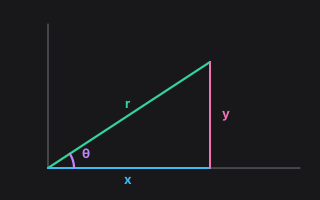
theta(default 60 degree). Use the unit menu when you need a different unit. - Click Calculate. The card evaluates $x=r\cos\theta$ and shows the result in the declared output unit; Result in (when present) converts that number.
The Science: A Rigorous Derivation (Approaching a Proof)
A complex number $x+iy$ is a point (or vector) in the plane. Its modulus $r = \sqrt{x^2+y^2}$ is the Euclidean length; its argument $\theta = \operatorname{atan2}(y,x)$ is the polar angle. Euler's formula $re^{i\theta} = r(\cos\theta + i\sin\theta)$ is the conversion. Multiplication of complex numbers adds arguments and multiplies moduli — the geometric reason De Moivre's theorem is true.
Dimensional check. The declared output unit is dimensionless; ToolBox evaluates the
formula in SI (radians internally for every trigonometric call) and python-calc converts to
the unit on the card.
History and Development
Argand (1806) and Gauss give the plane picture; Euler (1748) gives $e^{i\theta}$. The $\operatorname{atan2}$ two-argument arctangent, with a correct quadrant, is a 20th-century computing convention (Fortran, IEEE) solving the classical one-argument $\arctan(y/x)$ ambiguity.
Related Concepts: Complex Magnitude, Complex Argument, Imag From Polar