
Sinusoid Frequency⚠ unverified
Trigonometry / Waves · Frequency |B|/(2π) of A sin(Bx − C)
Parameters
| Input | Symbol | Unit | Default | Description |
|---|---|---|---|---|
| B | B | — | 2.0 | Angular coefficient |
| Output | Symbol | Unit | Description |
|---|---|---|---|
| f | f | — | Cycles per unit x |
The science & history
Understanding the Parameters
- B — Angular coefficient.
- Output f — Cycles per unit x.
How to Calculate
- Enter Angular coefficient as
B(default 2.0 dimensionless). Use the unit menu when you need a different unit. - Click Calculate. The card evaluates $f=|B|/(2\pi)$ and shows the result in the declared output unit; Result in (when present) converts that number.
The Science: A Rigorous Derivation (Approaching a Proof)
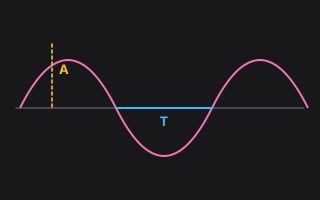
The general sinusoid $y = A\sin(Bx-C)+D$ is the unique solution of the harmonic oscillator with given amplitude, angular frequency $B$, phase and offset. Period $T = 2\pi/|B|$ is the $x$-interval of one full cycle; frequency is its reciprocal; phase shift $C/B$ slides the graph along $x$.
Dimensional check. The declared output unit is dimensionless; ToolBox evaluates the
formula in SI (radians internally for every trigonometric call) and python-calc converts to
the unit on the card.
History and Development
Harmonic analysis (Fourier, 1822) makes every reasonable periodic signal a sum of these terms. The $A,B,C,D$ parametrisation is the standard precalculus / signals-and-systems normal form.
Related Concepts: Sinusoid Period, Sinusoid Phase Shift