
Spherical Excess⚠ unverified
Geometry / Spherical · Spherical excess of a triangle
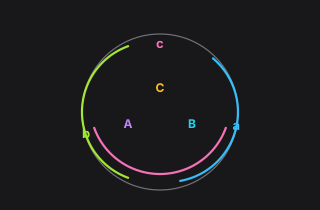
Parameters
| Input | Symbol | Unit | Default | Description |
|---|---|---|---|---|
| A | A | degree | 90 | Angle |
| B | B | degree | 90 | Angle |
| C | C | degree | 90 | Angle |
| Output | Symbol | Unit | Description |
|---|---|---|---|
| E | E | degree | Excess |
The science & history
Understanding the Parameters
- A (degree) — Angle.
- B (degree) — Angle.
- C (degree) — Angle.
- Output E (degree) — Excess.
How to Calculate
- Enter Angle as
A(default 90 degree). Use the unit menu when you need a different unit. - Enter Angle as
B(default 90 degree). Use the unit menu when you need a different unit. - Enter Angle as
C(default 90 degree). Use the unit menu when you need a different unit. - Click Calculate. The card evaluates $E=A+B+C-180^\circ$ and shows the result in the declared output unit; Result in (when present) converts that number.
The Science: A Rigorous Derivation (Approaching a Proof)
On a sphere of radius $R$, geodesics are great circles. A spherical triangle has sides that are themselves angles (central angles, or equivalently arc lengths divided by $R$). The spherical law of cosines $\cos c = \cos a\cos b + \sin a\sin b\cos C$ is the polar dual of the plane cosine law, recovered from the Euclidean cosine law in the tetrahedron formed by the three radii and the three chords. Girard's theorem says the area is the spherical excess $E = A+B+C-\pi$ times $R^2$: Gauss–Bonnet for a geodesic triangle on a surface of curvature $1/R^2$. L'Huilier's formula computes $E$ from the three sides, the spherical analogue of Heron.
Dimensional check. The declared output unit is degree; ToolBox evaluates the
formula in SI (radians internally for every trigonometric call) and python-calc converts to
the unit on the card.
History and Development
- Menelaus of Alexandria, Sphaerica (c. 100 CE). First systematic spherical trigonometry.
-
Islamic golden age. al-Battānī, Abū al-Wafāʾ, Nasīr al-Dīn al-Tūsī: the spherical sine law; essential for astronomy and qibla.
-
Regiomontanus, Napier, 15th–17th centuries. Napier's rules for right spherical triangles; the tool of celestial navigation.
-
Girard (1629) and Harriot. Area $= ER^2$. L'Huilier (1803) gives the side-based excess formula. Great-circle distance on Earth is this theory with $R \approx 6371\,\mathrm{km}$; on this site it is already implemented as Great-Circle Distance (Aerospace / Navigation).
Related Concepts: Great-Circle Distance, Spherical Law Of Cosines Side, Spherical Law Of Sines Side, Spherical Triangle Area, L Huilier Excess