
Triangle Area Heron⚠ unverified
Geometry / Plane · Triangle area from three sides (Heron's formula)
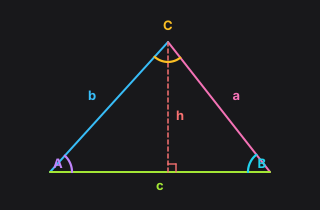
Parameters
| Input | Symbol | Unit | Default | Description |
|---|---|---|---|---|
| a | a | m | 3 | Length |
| b | b | m | 4 | Length |
| c | c | m | 5 | Length |
| Output | Symbol | Unit | Description |
|---|---|---|---|
| A | A | m^2 | Area |
The science & history
Understanding the Parameters
- a (m) — Length.
- b (m) — Length.
- c (m) — Length.
- Output A (m^2) — Area.
How to Calculate
- Enter Length as
a(default 3 m). Use the unit menu when you need a different unit. - Enter Length as
b(default 4 m). Use the unit menu when you need a different unit. - Enter Length as
c(default 5 m). Use the unit menu when you need a different unit. - Click Calculate. The card evaluates $A = \sqrt{s(s-a)(s-b)(s-c)}$ and shows the result in the declared output unit; Result in (when present) converts that number.
The Science: A Rigorous Derivation (Approaching a Proof)
With $s=(a+b+c)/2$, Heron's formula is the cosine-law area $\tfrac12 ab\sin C$ after eliminating $C$ via $\sin^2 C = 1-\cos^2 C$.
Plane Euclidean geometry is the geometry of the flat plane: points, lines, polygons and circles with the parallel postulate. Lengths add along a path; areas are the unique translation-invariant measure that assigns $1$ to the unit square. The Pythagorean theorem is the metric; trigonometry enters as soon as an angle is known, because $\sin$ and $\cos$ are the ratios that convert an angle into a length ratio.
Every formula in this family is a consequence of those two facts (additivity of length/area, and the Pythagorean metric) plus similarity of triangles. Sector and segment formulae additionally use the radian definition of angle, $\theta = s/r$.
Dimensional check. The declared output unit is m^2; ToolBox evaluates the
formula in SI (radians internally for every trigonometric call) and python-calc converts to
the unit on the card.
History and Development
-
Euclid, Elements (c. 300 BCE). Books I–IV axiomatise the plane; I.47 is the Pythagorean theorem; Book II treats geometric algebra that later becomes Heron and the parallelogram law.
-
Archimedes (3rd century BCE). Quadrature of the parabola and the circle (area $\pi r^2$ as the limit of inscribed polygons); Measurement of a Circle.
-
Heron of Alexandria (1st century CE). Metrica gives $\sqrt{s(s-a)(s-b)(s-c)}$ for a triangle from three sides — a formula already known to Archimedes.
-
Islamic and medieval transmission. al-Khwārizmī, Thābit ibn Qurra and later Fibonacci carry the Euclidean corpus into Latin Europe.
-
Modern form. Cartesian coordinates (Descartes, 1637) turn these geometric statements into algebra; radians (Roger Cotes / Euler) make $s = r\theta$ and sector area $\tfrac12 r^2\theta$ exact without a $180/\pi$ factor.
Related Concepts: Law Of Sines Side, Law Of Cosines Side, Distance 2D, Triangle Perimeter, Rectangle Perimeter, Regular Polygon Perimeter, Circle Circumference, Triangle Third Angle, Polygon Interior Angle Sum, Regular Polygon Interior Angle