
Angle Between Two Lines⚠ unverified
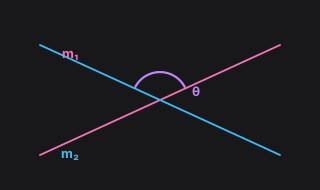
Geometry / Analytic · Acute angle between two lines given their slopes
Parameters
| Input | Symbol | Unit | Default | Description |
|---|---|---|---|---|
| m1 | m1 | — | 1.0 | Slope of first line |
| m2 | m2 | — | 0.0 | Slope of second line |
| Output | Symbol | Unit | Description |
|---|---|---|---|
| theta | θ | degree | Angle |
The science & history
Understanding the Parameters
- m_1 — Slope of first line.
- m_2 — Slope of second line.
- Output θ (degree) — Angle.
How to Calculate
- Enter Slope of first line as
m1(default 1.0 dimensionless). Use the unit menu when you need a different unit. - Enter Slope of second line as
m2(default 0.0 dimensionless). Use the unit menu when you need a different unit. - Click Calculate. The card evaluates $\tan\theta=\left|\frac{m_1-m_2}{1+m_1 m_2}\right|$ and shows the result in the declared output unit; Result in (when present) converts that number.
The Science: A Rigorous Derivation (Approaching a Proof)
Analytic geometry replaces figures with equations. A point is a tuple of real numbers; the Euclidean distance is the $2$-norm of their difference. A line $ax+by+c=0$ is a level set of a linear function, so the distance from a point to the line is that function's value divided by the norm of its gradient. Conics are the quadratic curves; completing the square on $x^2+y^2+Dx+Ey+F=0$ yields a circle; $e = c/a$ classifies ellipse ($e<1$), parabola ($e=1$) and hyperbola ($e>1$). Polar coordinates $(r,\theta)$ are the Euclidean plane written in rotationally natural coordinates.
Dimensional check. The declared output unit is degree; ToolBox evaluates the
formula in SI (radians internally for every trigonometric call) and python-calc converts to
the unit on the card.
History and Development
- Descartes, La Géométrie (1637), and Fermat. Coordinates as a method; the name “Cartesian.”
-
Apollonius of Perga (3rd century BCE). Conics — ellipse, parabola, hyperbola — centuries before coordinates, in purely geometric language.
-
Euler, Lagrange. Rotation of axes to eliminate $xy$ terms; classification of the general conic.
-
19th century. Vector geometry (Gibbs, Heaviside) rewrites point-to-plane and skew-line distance as $|(\mathbf{P}_2-\mathbf{P}_1)\cdot(\mathbf{d}_1\times\mathbf{d}_2)|/|\mathbf{d}_1\times\mathbf{d}_2|$.
Related Concepts: Distance 3D, Slope, Point To Line Distance, Circle Radius From General Form, Parabola Latus Rectum, Ellipse Eccentricity, Ellipse Linear Eccentricity, Hyperbola Eccentricity