
Cos Of Arcsin⚠ unverified
Trigonometry / Inverse · cos(arcsin x)
Parameters
| Input | Symbol | Unit | Default | Description |
|---|---|---|---|---|
| x | x | — | 0.6 | Argument in [-1, 1] |
| Output | Symbol | Unit | Description |
|---|---|---|---|
| c | cos(arcsin x) | — | Cosine |
The science & history
Understanding the Parameters
- x — Argument in [-1, 1].
- Output cos(arcsin x) — Cosine.
How to Calculate
- Enter Argument in [-1, 1] as
x(default 0.6 dimensionless). Use the unit menu when you need a different unit. - Click Calculate. The card evaluates $\sqrt{1-x^2}$ and shows the result in the declared output unit; Result in (when present) converts that number.
The Science: A Rigorous Derivation (Approaching a Proof)
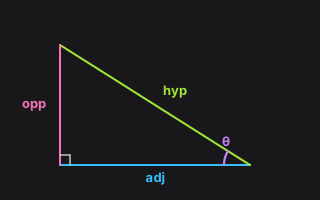
The inverse trigonometric functions undo the unit-circle maps on a chosen branch: $\arcsin:[-1,1]\to[-\pi/2,\pi/2]$, $\arccos:[-1,1]\to[0,\pi]$, $\arctan:\mathbb{R}\to(-\pi/2,\pi/2)$. Compositions such as $\sin(\arctan x) = x/\sqrt{1+x^2}$ are algebraic: draw the right triangle with opposite $x$ and adjacent $1$. All other solutions of $\sin\theta = y$ differ from the principal value by the general-period formula, which this calculator does not enumerate.
Dimensional check. The declared output unit is dimensionless; ToolBox evaluates the
formula in SI (radians internally for every trigonometric call) and python-calc converts to
the unit on the card.
History and Development
Inverse trigonometric functions enter analysis with Newton and Euler as integrals ($\arcsin' = 1/\sqrt{1-x^2}$, $\arctan' = 1/(1+x^2)$). Principal-value ranges were standardised in the 19th century so that computer libraries (and this site) have one number to return.
Related Concepts: Arcsine, Arccosine, Arctangent, Sin Of Arctan